Word Problems: Learning to Choose the Operation Before Calculating
Why pupils add every number in the problem, and how to teach them to understand the situation before calculating.
Read the articleLong sides, a tilted right angle, an “almost right” angle judged by eye: three common traps and simple set square checks to get past them.
A pupil can recite that an acute angle is “smaller than a right angle” and still go wrong as soon as two angles are shown side by side. The word is familiar; what it refers to is still blurry. Three mix-ups come up again and again, and each one can be fixed with a specific gesture.
Show two angles: one wide open with short sides, the other narrow with long sides. Many pupils point to the second one as the larger. They compare what they see best: the length of the lines, or the space the drawing takes up on the page.
To bring their attention back to the opening, have them copy one angle onto tracing paper and lay it over the other angle, vertex on vertex, one side along one side. The angle whose second side sticks out is the larger. Then have them extend the sides with a ruler: the angle stays the same even though the drawing gets bigger. This is often the moment it clicks.
In exercise books, right angles are nearly always drawn with one horizontal side and one vertical side. Pupils end up linking “right” with that position. Turn the figure and they no longer recognize it, and a square standing on one corner seems to have no right angles at all.
Vary the orientation from the very first lessons, and turn the sheet in front of the class: nothing in the figure changes, only its position. The same goes for acute and obtuse angles.
Angles of 80° or 100° are the most deceptive: by eye, they easily pass for right angles. This is the time to teach the set square check:
Without a set square, a sheet of paper folded twice, with the first fold laid back on itself, gives a perfect right angle. Every pupil can make one and keep it in their pencil case.
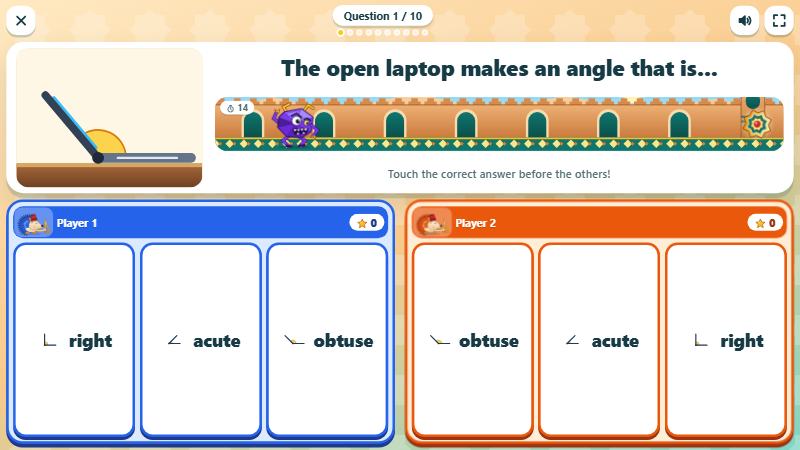 Angle FlashAcute, right or obtuse? The first to touch the correct answer stops Crookle.See the game
Clock hands at three o’clock, a door left ajar, a book lying open, a pair of scissors: everyday objects offer angles of every kind. Ask each group to find one of each type in the classroom, then prove it with their paper right angle. The reasoning counts as much as the answer.
Measuring in degrees comes later. At this stage, what matters is that pupils can compare an opening with the corner of the set square, and no longer accept “you can see it” as proof.
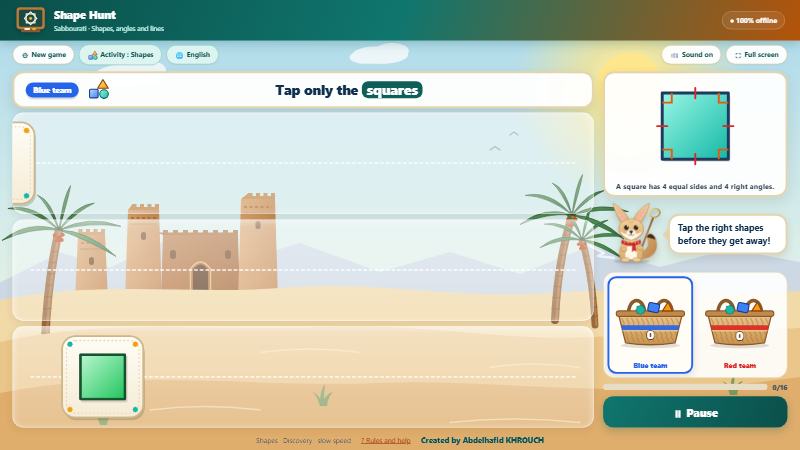 Shape HuntShapes scroll along three lanes. Tap the right ones before they get away.See the game
Why pupils add every number in the problem, and how to teach them to understand the situation before calculating.
Read the articleOne board, thirty pupils: how to organize teams and turns so that everyone is thinking during the game.
Read the articleSwapped hands, the wrong hour, misread minutes, 12-hour or 24-hour time, durations: five classic mistakes and practical ideas for the classroom.
Read the article