Acute, Right or Obtuse: Why Pupils Get Angles Wrong
Long sides, a tilted right angle, an “almost right” angle judged by eye: three common traps and simple set square checks to get past them.
Read the articleTwo words for one multiplication. How to help pupils tell multiples from factors, using tiles, pairs and three common traps worth teaching directly.
A pupil who knows the times tables can get every calculation right and still accept the sentence “6 is a multiple of 24”. Both words describe the same equation seen from two sides, and that is where the confusion starts.
Always start from a written multiplication: 24 = 6 × 4. It gives two sentences: 24 is a multiple of 6, and 6 is a factor of 24. Have pupils say both aloud from the same equation, with different numbers each time. When the sentence rests on a visible multiplication, the vocabulary no longer depends on memory alone.
One reference point helps hesitant pupils: apart from the case of 0, the multiple is the larger of the two numbers, or equal to the other.
A factor is easy to see with objects. Hand out 24 tiles and ask pupils to arrange them in equal rows. With 4 rows of 6, nothing is left: 4 and 6 are factors of 24. With 5 rows of 4, 4 tiles are left over: 5 is not a factor. A failed try gives information, so it should not be treated as a mistake.
The arrangement also shows why factors come in pairs. Each rectangle gives two of them: 1 and 24, 2 and 12, 3 and 8, 4 and 6. Search in order, 1, 2, 3…, and stop when the pairs meet.
For 2 and 5, look at the units digit. For 3 and 9, add up the digits. Pupils soon mix the two methods: a number ending in 3 looks divisible by 3. Have them check 143: 1 + 4 + 3 = 8, which is not a multiple of 3, so 143 is not divisible by 3. Conversely, 27 ends in neither 3 nor 9, yet it is divisible by both.
Five to ten minutes are enough for a focused activity: a wall of multiples at the start of the lesson, a number to arrange in rectangles, then a few sentences to judge true or false. Each time, ask for the equation that justifies the answer. In the game below, each mistake shows that equation or the remainder, and the results separate vocabulary mix-ups from times-table errors.
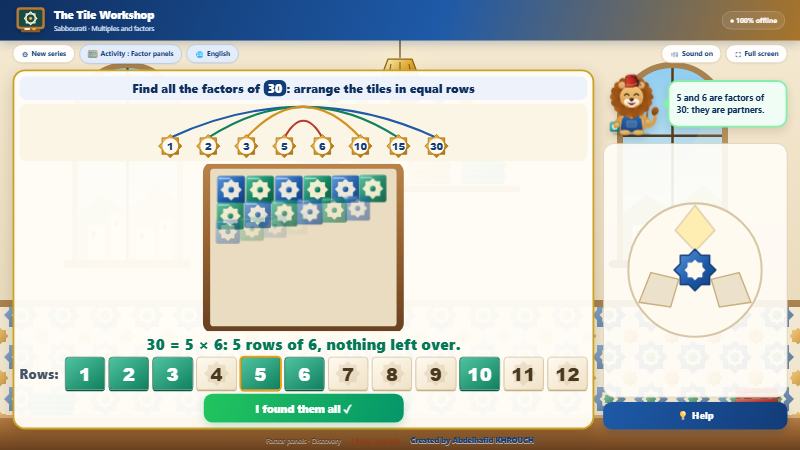 The Tile WorkshopMultiples, factors and divisibility with mosaic tiles to arrange in rectangles.See the game
Long sides, a tilted right angle, an “almost right” angle judged by eye: three common traps and simple set square checks to get past them.
Read the articleWhy pupils add every number in the problem, and how to teach them to understand the situation before calculating.
Read the articleOne board, thirty pupils: how to organize teams and turns so that everyone is thinking during the game.
Read the article