 Numbers
The Tile Workshop
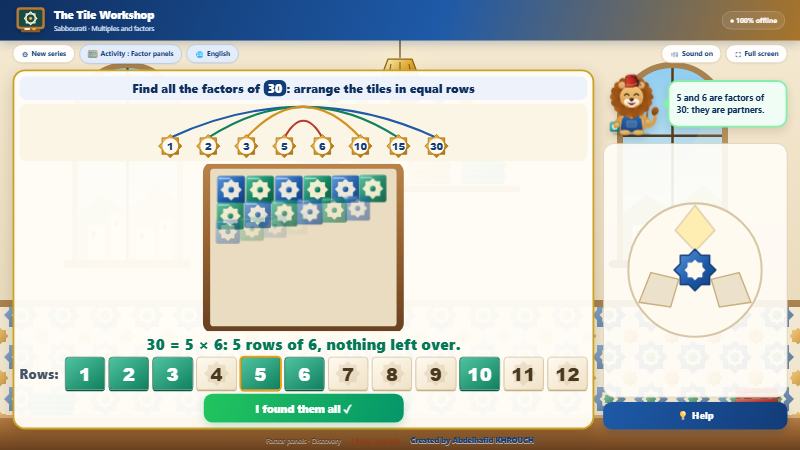
A lion cub tile-setter lays out the tiles. Pupils tap multiples on a wall of one hundred tiles, arrange tiles in equal rows to find factors, look for the lowest common multiple and the highest common factor, then apply divisibility rules. After each mistake, the cub explains why.
 Start the game
The game opens full page, with no ads and no sign-up.
- Level
- Grades 4–5
- Way of playing
- Solo or in teams
- Suggested time
- 15 to 20 min
- Game languages
- Arabic · French · English · Spanish
- Price
- Free
What pupils practice
- Recognize the multiples of a number, remembering that 0 is one of them.
- Find all the factors of a number using pairs (24 = 4 × 6).
- Work out the lowest common multiple (not 0) and the highest common factor.
- Use the divisibility rules for 2, 3, 5 and 9, and tell even and odd numbers apart.
How to play
- Choose the activity, level and series length, or the number of teams for the battle.
- On the wall, tap all the multiples asked for. A cracked tile shows the division and its remainder.
- On the panels, choose a number of rows: a complete rectangle gives two factors, and leftover tiles show it is not a factor.
- The results sort the mistakes: multiple and factor mixed up, misleading last digit, the cases of 0 and 1, incomplete search.
In the classroom
At the board, have pupils say the equation before tapping: “24 = 6 × 4, so 24 is a multiple of 6 and 6 is a factor of 24.”
In the battle, 2 to 4 teams take turns: answer the card, then line up 4 tiles. Seated pupils check on their slates.
Useful settings
- Three levels: Discovery (wall up to 49), Practice (wall up to 99) and Expert (large numbers).
- On the panels, trying a number of rows that does not work never counts as a mistake.
- The game can be played in English, French, Spanish and Arabic.