Acute, Right or Obtuse: Why Pupils Get Angles Wrong
Long sides, a tilted right angle, an “almost right” angle judged by eye: three common traps and simple set square checks to get past them.
Read the articleA multiplication chart has 100 squares, but only a few facts are truly hard. Understand, rebuild, then make them automatic: a sequence for the whole class.
To find 7 × 8, many pupils recite the 7 times table from the start: 7, 14, 21, 28… They get there in the end, but slowly, and one counting slip along the way gives 49 or 63. Reciting a table is not knowing it: a fact is known when the answer comes on its own, without counting.
A 1 to 10 multiplication chart has 100 squares. But 6 × 4 and 4 × 6 give the same answer, so there are only 55 different products. The 1, 2, 5 and 10 times tables come almost for free. That leaves 21 products to really memorise, including 6 square numbers such as 7 × 7. Tell your pupils: the mountain becomes a hill.
A product is a set of equal rows. 6 × 4 is 6 rows of 4 counters. Turn the grid a quarter turn and you see 4 rows of 6: the answer stays the same, and pupils see why they only need to learn half the chart.
Have pupils build rectangles with counters or on squared paper, then count row by row: 6, 12, 18, 24. This skip counting later becomes their safety net.
Before working on speed, give pupils strategies to rebuild one fact from another:
A strategy is not the goal: it helps out while memory is being built.
Memorisation improves with short, frequent sessions: ten minutes a day works better than an hour a week. Mix the questions instead of following the order of the table, bring a missed fact back soon, and ask the question the other way round too: 7 × ? = 56. The missing number prepares the ground for division.
Finally, set a speed goal. In Times Table Mosaic, a square only becomes a mosaic tile after two correct answers in under six seconds, and a missed fact comes back a few questions later.
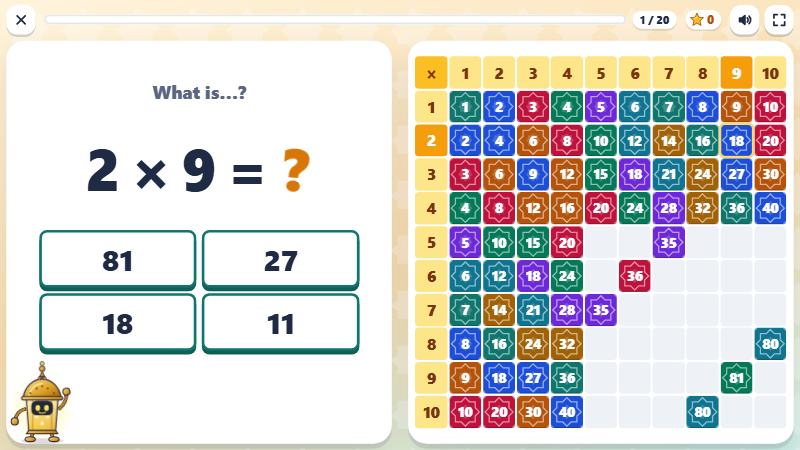 Times Table MosaicTimes tables practice: every mastered fact becomes a mosaic tile.See the game
Well-known tables also show in written calculation: many mistakes in long multiplication are really times table mistakes.
 The Magic ColumnWritten addition, subtraction and multiplication, digit by digit, carrying included.See the game
Long sides, a tilted right angle, an “almost right” angle judged by eye: three common traps and simple set square checks to get past them.
Read the articleA Roman numerals chart from 1 to 100, the 7 symbols, the 4 rules for writing them and the mistakes pupils make most often (IIII, IL, VV), with a game to practise.
Read the articleWhy pupils add every number in the problem, and how to teach them to understand the situation before calculating.
Read the article