Acute, Right or Obtuse: Why Pupils Get Angles Wrong
Long sides, a tilted right angle, an “almost right” angle judged by eye: three common traps and simple set square checks to get past them.
Read the articleA Roman numerals chart from 1 to 100, the 7 symbols, the 4 rules for writing them and the mistakes pupils make most often (IIII, IL, VV), with a game to practise.
Pupils meet Roman numerals everywhere: on clock faces, in chapter headings, in the names of kings and queens and in film credits. Yet many read XL as 60 or write IIII for 4. With 7 symbols and 4 rules, the whole system fits on one page.
I is 1, V is 5, X is 10, L is 50, C is 100, D is 500 and M is 1000. The values always grow the same way: multiply by 5, then by 2, and so on (1, 5, 10, 50, 100, 500, 1000). There is no symbol for zero: the Romans did not need one to write their numbers.
The fourth rule is the most useful in class: it links Roman numerals to the place value pupils already know.
Each row starts with a ten; each column adds ones. To write 47, take the row for 40 (XL) and the column for 7 (VII): XLVII. 100 is C.
| tens + ones | 0 | 1 | 2 | 3 | 4 | 5 | 6 | 7 | 8 | 9 |
|---|---|---|---|---|---|---|---|---|---|---|
| 0 | – | I | II | III | IV | V | VI | VII | VIII | IX |
| 10 | X | XI | XII | XIII | XIV | XV | XVI | XVII | XVIII | XIX |
| 20 | XX | XXI | XXII | XXIII | XXIV | XXV | XXVI | XXVII | XXVIII | XXIX |
| 30 | XXX | XXXI | XXXII | XXXIII | XXXIV | XXXV | XXXVI | XXXVII | XXXVIII | XXXIX |
| 40 | XL | XLI | XLII | XLIII | XLIV | XLV | XLVI | XLVII | XLVIII | XLIX |
| 50 | L | LI | LII | LIII | LIV | LV | LVI | LVII | LVIII | LIX |
| 60 | LX | LXI | LXII | LXIII | LXIV | LXV | LXVI | LXVII | LXVIII | LXIX |
| 70 | LXX | LXXI | LXXII | LXXIII | LXXIV | LXXV | LXXVI | LXXVII | LXXVIII | LXXIX |
| 80 | LXXX | LXXXI | LXXXII | LXXXIII | LXXXIV | LXXXV | LXXXVI | LXXXVII | LXXXVIII | LXXXIX |
| 90 | XC | XCI | XCII | XCIII | XCIV | XCV | XCVI | XCVII | XCVIII | XCIX |
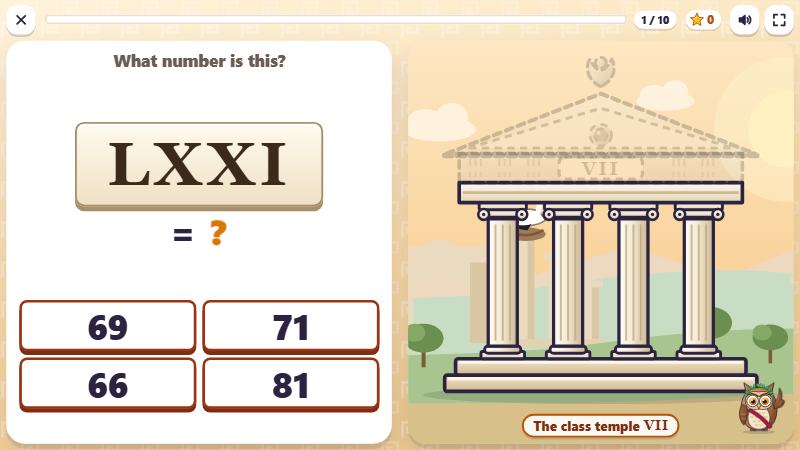 Roman Numeral TempleRead, write and compare Roman numerals: every correct answer adds a stone to the temple.See the game
Writing a number in Roman numerals starts with splitting it into hundreds, tens and ones, which makes it a good time to revisit place value.
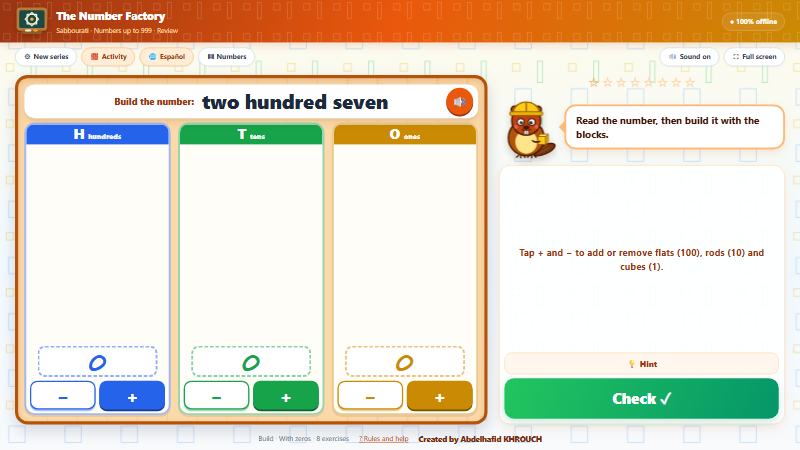 The Number FactoryBuild, write, break apart and place numbers with flats, rods and cubes.See the game
Long sides, a tilted right angle, an “almost right” angle judged by eye: three common traps and simple set square checks to get past them.
Read the articleWhy pupils add every number in the problem, and how to teach them to understand the situation before calculating.
Read the articlePupils compare fractions as if they were whole numbers. Sharing, equivalent fractions and common denominators: a progression to fix that habit.
Read the article