Acute, Right or Obtuse: Why Pupils Get Angles Wrong
Long sides, a tilted right angle, an “almost right” angle judged by eye: three common traps and simple set square checks to get past them.
Read the articlePupils compare fractions as if they were whole numbers. Sharing, equivalent fractions and common denominators: a progression to fix that habit.
“4 is bigger than 3, so 1/4 is bigger than 1/3.” This reasoning turns up in almost every class. It is not silly: the pupil is applying what they know about whole numbers. The whole job is to show them that, with fractions, this habit no longer works.
Start with a real sharing situation. Cut one flatbread into 3 pieces, then an identical one into 4 pieces. Which piece would you rather have? Pupils see straight away that sharing among more people gives each person less. The denominator tells you how many pieces the whole is cut into: the bigger it is, the smaller each piece.
Paper strips of the same length give the same experience on a table: one strip folded into 2, another into 4, another into 8. Line them up and compare the pieces.
A fraction is written with two numbers, but it stands for just one. To make this stick, have pupils place fractions on a number line from 0 to 1, then beyond. They see that 3/3 lands on 1, 2/3 comes before it and 4/3 after it: comparing the numerator with the denominator tells you whether a fraction is greater than 1.
Cut each half of a strip in two and you get quarters: 1/2 = 2/4. Cut each half in three and you get sixths: 1/2 = 3/6. The rule “multiply the numerator and the denominator by the same number” then becomes a description of what was done with the scissors, not a formula to memorize.
To compare 2/3 and 3/4, look for a way of cutting both strips into the same pieces: twelfths. 2/3 = 8/12 and 3/4 = 9/12, so 3/4 is larger. Start with cases where one denominator is a multiple of the other, such as 2/3 and 5/6, before cases where a common multiple has to be found.
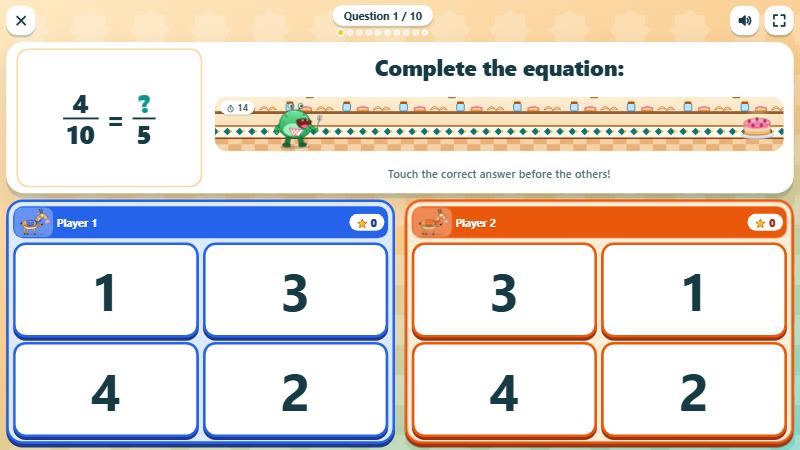 Fraction FlashEquivalent fractions, simplifying, common denominators: the first to find the answer stops the Gobbler.See the game
Finding a common denominator means finding a common multiple of both denominators, which makes it a good moment to review multiples.
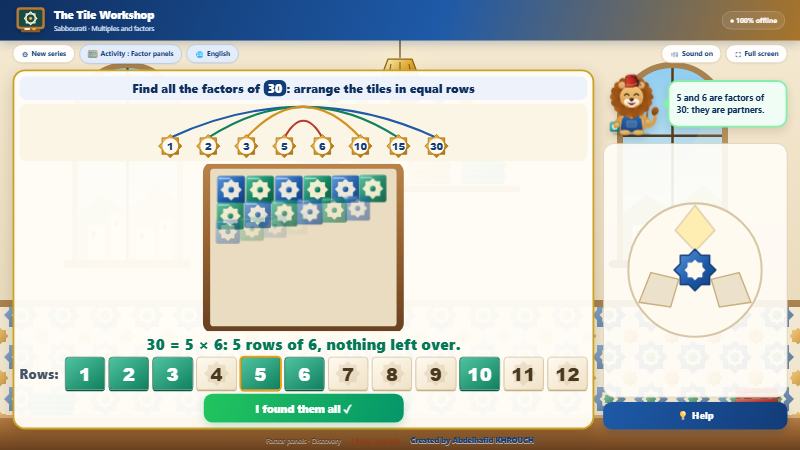 The Tile WorkshopMultiples, factors and divisibility with mosaic tiles to arrange in rectangles.See the game
Long sides, a tilted right angle, an “almost right” angle judged by eye: three common traps and simple set square checks to get past them.
Read the articleA Roman numerals chart from 1 to 100, the 7 symbols, the 4 rules for writing them and the mistakes pupils make most often (IIII, IL, VV), with a game to practise.
Read the articleWhy pupils add every number in the problem, and how to teach them to understand the situation before calculating.
Read the article